
How to Choose Stretch Film Thickness for Pallet Wrapping
2026-07-17
For factory buyers, warehouse teams, distributors, and packaging wholesalers, how to choose stretch film thickness for pallet wrapping is not a small buying question. Film that is too weak may tear on box corners. Film that is too heavy may waste money on every pallet. Between those two problems is the right choice. Film that holds the load runs well in daily packing. It also keeps the cost per wrapped pallet under control.
A pallet may look stable when it leaves the packing area. The real test comes later. Forklifts turn fast. Trucks shake. Export pallets may sit in storage for days or weeks. During that time, the wrong pallet wrapping film thickness can lead to loose cartons. It can also cause damaged boxes and extra repacking work.
Why Stretch Film Thickness Matters in Pallet Wrapping
Stretch film thickness affects holding force. It also affects puncture resistance, tear strength, cling, and pallet wrapping cost. A light, square pallet of cartons may only need thin film. A mixed pallet with sharp corners, gaps, or uneven height needs stronger industrial pallet wrap.
Roll price alone can be misleading. A cheaper roll may break more often. It may need more layers or slow workers down. For B2B buyers, the better number to watch is cost per wrapped pallet. That number gives a clearer view of real film use, labor time, and damage risk.
What Does Stretch Film Thickness Mean?
Understanding Stretch Wrap Gauge, Mil, and Micron
Stretch wrap gauge is a common way to describe stretch film thickness. Mil and micron are also used in product sheets. One mil equals 0.001 inch. One micron equals 0.001 millimeter. A higher gauge usually means a thicker film. But thickness is not the only thing that matters.
A basic stretch film gauge chart often shows 60 gauge as about 0.60 mil or 15 microns. It shows 80 gauge as about 0.80 mil or 20 microns. It also shows 100 gauge as about 1.00 mil or 25 microns.
Why Thicker Is Not Always Better
Thicker film can give more strength. But it also uses more material. For light cartons, that extra film may not add much safety. For sharp or heavy pallets, thin film may tear before it can hold the load. The best stretch film thickness is the one that fits the pallet. It is not always the thickest one on the shelf.
Common Stretch Film Thickness Options and Uses
Thin Stretch Film for Light Loads
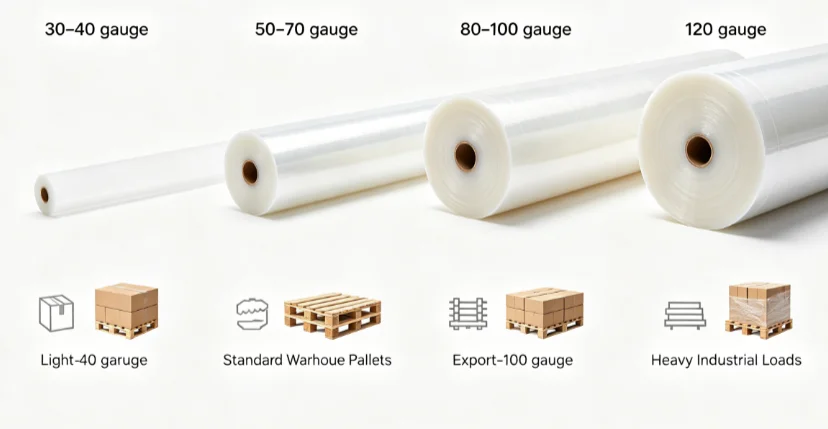
Thin film, such as 30–40 gauge film, is often used for small cartons. It works for light pallets and short warehouse moves. It can work well as pallet wrap for manual use when the load is clean and even. It is not a good match for rough handling or sharp box corners.
Medium Stretch Film for General Pallet Wrapping
For normal warehouse work, 50–70 gauge film is often used on standard boxed goods. This range gives a fair mix of cost and holding force. It fits many food cartons, e-commerce boxes, factory goods, and regular shipping pallets.
Heavy-Duty Stretch Film for Export Pallets
For heavier loads, long-distance trucking, export shipments, or uneven pallets, 80–100 gauge film is more common. Stretch film for heavy pallets needs better puncture resistance and stronger pull. In higher-risk cases, such as machinery parts, drums, building materials, or mixed industrial goods, 120 gauge stretch film may be chosen for added strength.
Key Factors When Choosing Stretch Film Thickness
Load Weight and Load Shape
Heavy pallets need stronger holding force. Shape matters too. A neat pallet of same-size cartons is easier to wrap than a pallet with gaps, sharp edges, or mixed box sizes. For rough loads, thicker film or corner protection can help prevent punctures.
Hand Stretch Film Thickness vs Machine Stretch Film Thickness
Hand stretch film thickness should be easy for workers to pull. If the film is too stiff, tension becomes uneven. Machine stretch film thickness must fit the stretch film wrapping machine. It must also fit the pre-stretch setting and pallet speed. A film that works by hand may not run well on a machine.
Regular Stretch Film vs Pre-Stretched Stretch Film
Pre-stretched stretch film is stretched during production. So it can be easier to apply and may help reduce stretch film waste. Regular stretch film is often used when stronger wrap force is needed. The right choice depends on pallet weight, packing speed, and the target cost per wrapped pallet.
How B2B Buyers Should Test Stretch Film Before Bulk Orders
Bulk orders should be tested on real pallets. They should not only be judged by a sample roll. A proper pallet load testing process should use the same cartons, pallet height, load weight, packing method, and transport route used in daily work.
During the test, buyers should check film breaks, corner tears, cling, roll weight, pallet movement, and the number of wraps needed. Stretch film quality control should also include film clarity, roll length, net weight, thickness tolerance, and packing condition.
About Weide Chuangyi Packaging
Weide Chuangyi Packaging is located in Foshan and focuses on packaging materials including PP strap, PET strap, fully automatic PP strap, semi-automatic PP strap, Stretch Film, and Paper corner protector. The company was founded in 2004 and has a 10,000-square-meter independent factory building. It combines R&D, production, and sales.
The company has 21 years of packing belt production experience and 12 product inspection standards. For pallet wrapping, the product range includes Machine Stretch Film and Hand Stretch Film. The material is described as ultra-thin, tough, transparent, self-adhesive, and low-temperature resistant. This makes it suitable for protective packaging and pallet wrapping.
Conclusion
The best way to decide how to choose stretch film thickness for pallet wrapping is to look at the load first. Light cartons may use thinner hand stretch film. Heavy export pallets may need stronger industrial stretch wrap thickness. B2B buyers should compare stretch film thickness, wrapping method, pallet load stability, roll accuracy, and cost per wrapped pallet before placing a bulk order.
FAQs
Q1:What stretch film thickness is best for pallet wrapping?
A:The best stretch film thickness depends on pallet weight, carton shape, handling method, and shipping distance. Light pallets may use 30–40 gauge film. Heavier industrial pallets often need 80 gauge stretch film or higher.
Q2:Is 80 gauge stretch film enough for heavy pallets?
A:80 gauge stretch film can work for many heavy pallets and general industrial pallet wrap jobs. Very sharp, unstable, or long-distance export loads may need 100 gauge or 120 gauge film.
Q3:How do I know if my stretch film is too thin?
A:Stretch film may be too thin if it breaks during wrapping. It may also tear at corners, lose cling, let the pallet move, or make workers add too many layers.
Q4:Does thicker stretch film always protect pallets better?
A:Thicker stretch film can improve puncture resistance and holding force. But it is not always the best choice. Film quality, wrapping tension, pallet shape, and stretch film quality control also affect the result.
Q5:How can B2B buyers reduce stretch film cost?
A:B2B buyers can improve stretch film cost savings by testing real pallets. They can avoid over-wrapping and check roll weight. They should choose the right stretch wrap gauge. They can also compare cost per wrapped pallet instead of only roll price.

