
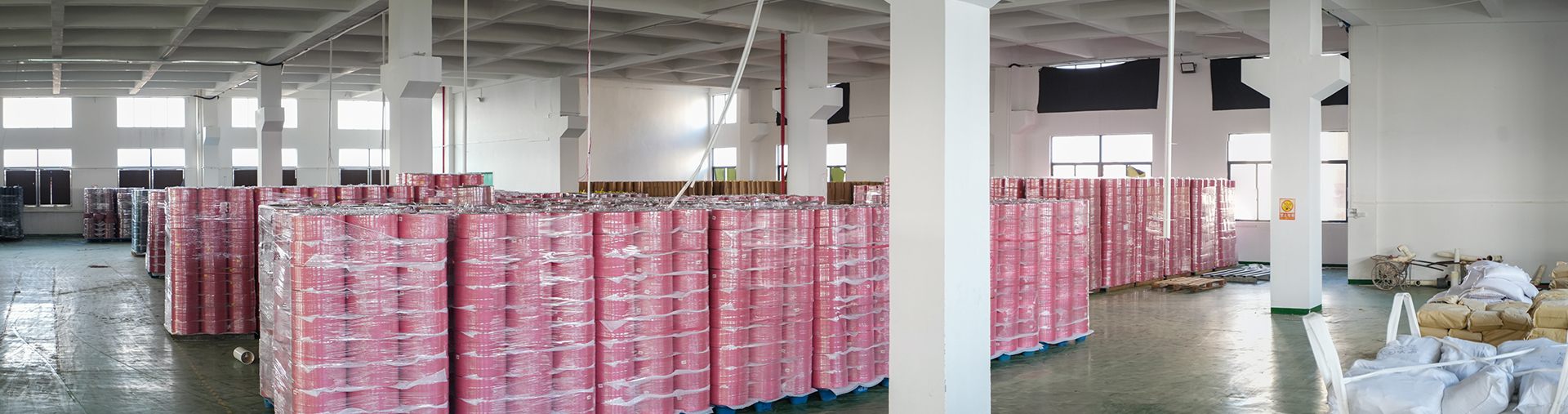
High-Strength PP Strapping: Material Formulation & Manufacturing
2026-10-15High-Strength PP Strapping Starts With the Polymer Structure
When a strap snaps at a pallet corner, the failure often began inside the polymer long before the machine pulled it tight. High-strength PP strapping relies on polypropylene chains that can stretch, recover, and hold tension through handling. The grade, additive package, cooling rate, and stretching ratio all shape that behavior.
Polypropylene strapping is used for light and medium-sized cargo, carton packaging, and pallet fixing. Its low density keeps roll weight manageable. Good plasticity and bending resistance help the band travel around corners and resist splitting. A clean surface pattern adds grip during feeding and sealing.
Polypropylene Resin Sets the Starting Point
Homopolymer PP gives the strap a more regular chain structure. That structure supports tensile impact performance and helps the band keep a consistent feel across the roll.
The product range described for this application includes white, transparent, translucent, yellow, red, and blue options. Width, thickness, color, and printed LOGO information can be specified for a packing line.
Nucleating Agents Shape Crystallinity
During cooling, PP chains form crystalline regions inside an amorphous matrix. A nucleating agent at 5% to 8% is a proposed formulation range for raising crystallinity above 65%.
The exact result depends on resin grade, dispersion, and cooling conditions, so you should confirm it with differential scanning calorimetry or an equivalent internal test. Color masterbatch should stay within the plant’s validated limit. The supplied process reference lists 3‰ as a control point.
How Does Double-Oriented Stretching Build Tensile Strength?
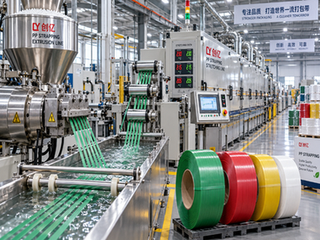
Stretching changes the direction of the molecular chains. That is the part operators notice when a band feels firm during tensioning yet bends around a box without a sharp crack. A stable line records the melt temperature, draw ratio, cooling water temperature, and line speed for each batch.
Longitudinal and Transverse Orientation
Longitudinal stretching aligns chains along the main load path. A controlled transverse step balances edge stability and handling. A target range of 12 to 18 kN/m can be used for development work, provided the test method, specimen width, thickness, and conditioning time appear on the report. Without those details, the number cannot predict machine performance.
Melt Temperature and Quench Cooling
The process reference places PP melt temperature around 220 to 240°C. Water quenching then limits excessive spherulite growth and gives the strip a more even microstructure. Small temperature swings can change surface finish and weld behavior. Operators usually see this first as a change in feed feel or a weaker friction-welded joint.
Which Process Details Matter on an Automatic Baler?
An automatic baler works in short cycles. The strap feeds, turns a corner, reaches tension, seals, and cuts within seconds. A roll that looks fine by hand can still cause jams when friction, thickness, or weld strength drifts.
Friction Coefficient and Surface Pattern
Homopolymer PP and a controlled surface treatment can reduce dynamic friction by a reported 30% against a defined reference. Record the reference material, load, speed, and test instrument before using that figure in a specification. Embossed or patterned surfaces add slip resistance at the joint while a smooth end face helps the strap pass through guides.
Width, Thickness, and Roll Length
Common PP specifications in the product material are 1206, 1208, 1507, 1508, and 1510, with custom sizes available. Fully automatic machines often use bands around 6 to 13 mm wide and 0.6 to 0.9 mm thick, but the baler manual remains the final check. A 5mm PP strapping tape fits narrow applications such as cartons and cloth bundles. Measure the guide slot before ordering.
The knowledge base also lists practical roll references: manual bands near 500 m, general-purpose bands around 1,000 m, and transparent bands near 2,500 m. Gross roll weights of 8.5 or 10.5 kg, including a 0.5 kg paper core, are common reference points. Ask for the actual net length on the quotation because resin density and thickness change meterage.
PP vs PET Strapping Bands: Which One Fits Your Load?
The word plastic steel is used differently in purchasing conversations. PP strapping serves many carton and light industrial jobs. PET strapping, also called polyester or plastic steel strapping, carries higher loads and keeps tension during long transport. Match the material to load weight, impact, weather, and equipment.
PP Strapping for Cartons and Pallets
PP packing tape suits household appliances, food, printing, medicine, chemicals, textiles, doors and windows, and logistics packaging. Manual, semi-automatic, and automatic balers can use it. The band is light, bends readily, and can be sealed by heat or friction welding when the machine supports that method.
PET Strapping for Heavy Loads
PET bands are supplied in green and black, with common references such as 1508, 1608, 1609, and 1910. They work with pneumatic and electric balers. PET keeps about 5% residual tension in the supplied reference and can extend about 5% under a strong impact.
Smooth edges reduce hand injuries and package scratches. The material resists moisture, temperature changes from about -50 to 100°C, and rust, and it can enter a recycling stream.
What Should You Check Before Buying a Strapping Band?
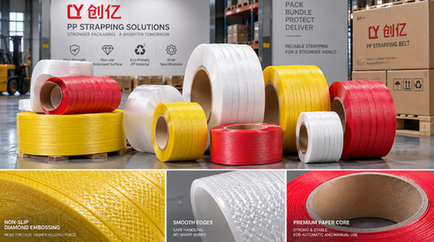
Start with a sample roll and the actual baler. Look at the cross-section, edge, texture, thickness, and cleanliness. A good band has an even thickness, smooth edges, clear embossing, and little dust shedding.
Run tensile, weld, rebound, and friction checks. Note width, thickness, roll length, gross weight, and length-to-weight ratio. For sea freight or outdoor storage, add moisture and ultraviolet stability checks. On the line, record feed, tension, seal, cut, and jam events. One short trial often reveals more than a long product sheet.
Matching Formulation Control With Practical Supply Support
Weide Chuangyi Packaging supplies PP strapping for manual, semi-automatic, and automatic balers, plus PET options for pneumatic and electric equipment. The strap series includes fully automatic PP strapping, 5mm PP strapping tape, and custom PP/PET colors or LOGO printing.
For a useful recommendation, prepare the cargo weight, pallet size, baler model, guide-slot dimensions, target width and thickness, and shipping environment. Those details connect material formulation to a roll that feeds cleanly and seals at the required tension. Product information is available on the company website and the strap series page.
FAQ
Q1: What makes high-strength PP strapping different from ordinary PP packing tape?
A: Resin grade, crystallinity, molecular orientation, thickness control, and validated stretching and cooling conditions determine tensile and feeding behavior.
Q2: Is 12 to 18 kN/m suitable for every automatic baler?
A: No. Treat it as a development target and check the machine’s approved width, thickness, tension, and test standard.
Q3: When does PET strapping suit a load?
A: PET suits loads that need higher retained tension, stronger impact resistance, or longer exposure to outdoor and humid conditions.
Q4: Can a 5mm PP strapping tape run on a standard baler?
A: Only when the guide slot, feed wheels, tension setting, and sealing unit accept a 5 mm band. Confirm those dimensions before purchase.
Q5: Which data should appear on a strapping band quotation?
A: List material, width, thickness, roll length, core size, color, tensile target, weld method, packing weight, and the compatible baler model.
