

PP vs. PET Strapping: Choosing the Right Packaging Option
2026-08-07

A strap can look fine when it leaves the packing station and still fail later. Cartons settle, pallets shift, rain reaches an outdoor storage area, or a worker selects a roll that does not fit the machine. This is why a useful PP vs PET strapping comparison must cover more than breaking strength.
Both materials belong to the wider category of packaging strapping, but they solve different problems. PP strapping usually suits cartons and light to medium loads. PET strapping holds higher tension and is often the better choice for heavy pallets, long trips, and changing weather.
What Is PP Strapping?
PP strapping, also called polypropylene strapping, is a lightweight plastic strapping material. It has good flexibility, bending resistance, and tensile impact performance. The material’s low density also helps keep each roll manageable on a busy packing line.
Where PP Strapping Works Best
PP strapping for cartons is common in food, printing, textiles, household appliances, medicine, retail distribution, and general logistics. It can bundle products or secure lighter goods to a pallet.
PP strapping for light loads makes sense when the package does not need high retained tension. A semi-automatic strapping machine can handle frequent carton work, while an automatic strapping machine suits faster production lines. Manual tools remain useful when packing happens at different points around a warehouse.
Common PP strapping specifications include 1206, 1208, 1507, 1508, and 1510. Available colors may include white, transparent, translucent, yellow, red, and blue. Color, size, and printed logos can also be customized.
Main Benefits and Limits
A quality PP packing strap has a clean surface pattern, smooth ends, and an embossed texture that helps prevent slipping. Good polypropylene strap should not shed dust or show frayed edges. Thickness needs to stay consistent, especially when PP strapping for automatic machines must feed through guides at speed.
The main limit is tension retention. PP can relax after strapping, particularly when a carton compresses during storage. Low price does not help much if loose bands lead to a leaning pallet. That small detail is easy to miss at the packing table.
What Is PET Strapping?
PET strapping, or polyester strapping, has higher tensile strength and holds tension longer than PP. It is often called plastic steel strapping because it can replace steel in many industrial packaging jobs. Still, every replacement should be checked against the actual load and shipping conditions.
Where PET Strapping Works Best
PET strapping for heavy loads is widely used with timber, paper, steel, aluminum, glass, ceramics, panels, building materials, and chemical fiber products. PET strapping for pallets also suits dense or rigid cargo that may shift during handling.
For PET strapping for export packaging, moisture resistance and long-term load stability matter as much as initial tension. The material does not rust, handles weather changes, and absorbs shocks during transport. Supplier data may state stability from -50°C to 100°C, but you should confirm the grade and test conditions before using that range in a purchasing specification.
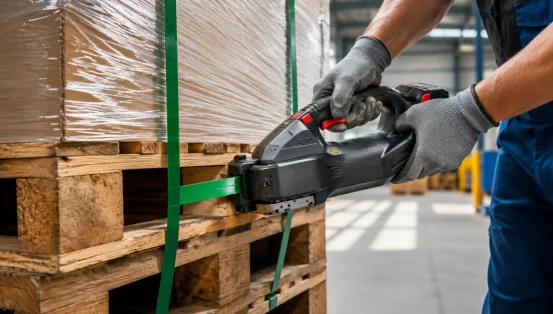
Common PET strapping specifications include 1508, 1608, 1609, and 1910. Green and black are standard options. Pneumatic tools and portable electric balers can tension and join the strap through friction welding.
Main Benefits and Limits
A good PET packing strap combines high breaking strength with controlled elongation. That balance helps the strap absorb an impact without immediately releasing the load. Its smooth edges are also safer to handle than sharp steel bands and are less likely to scratch packaged goods.
PET is a practical steel strapping alternative, but it is not always the lowest-cost choice for light cartons. Heavy-duty strapping also requires the right tension setting. Too much force can crush weak packaging even when the strap itself performs perfectly.
How Does PP Strapping vs PET Strapping Compare?
This packaging strap comparison should start with the load rather than the roll price. The best strapping for packaging is the material that keeps the shipment stable without adding needless cost or slowing the packing process.
| Selection Factor | PP Strapping | PET Strapping |
|---|---|---|
| Typical load | Light to medium | Medium to heavy |
| Tension retention | Lower | Higher |
| Flexibility | More flexible | Stiffer |
| Main use | Cartons and bundles | Pallets and industrial loads |
| Weather exposure | Routine indoor use | Humid, outdoor, or long-term storage |
| Equipment | Manual, semi-automatic, automatic | Manual, pneumatic, electric |
| Initial cost | Usually lower | Usually higher |
Strength and Load Stability
Strapping tensile strength varies with material, width, thickness, and production quality. A wider band is not automatically better if its thickness is uneven or its joint fails early.
PET normally provides greater breaking strength. PP works well when the load is lighter or slightly compressible. For either material, joint efficiency matters. A strong strapping band with a weak seal is still a weak package.
Weather and Transport Conditions
PET offers better tension retention during long storage and rough transport. Its impact resistance also helps when forklifts, trucks, and loading docks subject a pallet to repeated movement.
Weather-resistant strapping is useful for outdoor storage, while moisture-resistant strapping avoids the rust problem linked with steel. PP remains a sensible choice for clean indoor carton packing where the storage period is short.
Equipment and Operating Cost
Check strapping tool compatibility before ordering. Strap width and thickness must fall within the tool’s rated range. One pneumatic machine, for example, may accept PP or PET from 13 to 25 mm wide and 0.4 to 1.5 mm thick. Portable electric equipment may accept 13 to 16 mm widths and 0.4 to 1.2 mm thicknesses.
A fair strapping cost comparison includes roll length, labor, seal quality, machine stoppages, and damaged shipments. PP often wins on routine carton work. PET may cost less per secured heavy load because it stays tight and reduces rework.
How Should You Choose PP or PET Strapping?
A practical strapping selection guide starts with five checks:
-
Record the load weight, pallet size, and package shape.
-
Decide whether the goods are rigid, compressible, or fragile.
-
Review transport distance, handling frequency, moisture, and storage time.
-
Match the strapping width and thickness to your equipment.
-
Test tensile strength, bonding strength, edges, dust, and thickness consistency.
Choose PP or PET strapping only after a trial on the real package. PP strapping for light loads is economical and easy to run. PET strapping for heavy loads gives better restraint when a pallet must survive long transport or outdoor storage.
Both are recyclable strapping materials where suitable collection systems exist.
A Practical Supplier Choice
Weide Chuangyi Packaging merges product development, manufacturing, and sales. This setup works well if a standard roll doesn’t fit your packing line. Their PP strapping specs handle manual, semi-automatic, and automatic jobs. Meanwhile, the PET strapping line fits pneumatic and portable electric tools.
The maker modifies colors, dimensions, and logo prints for PP and PET products. They also supply related items. These include buckles, tensioners, sealers, stretch film, and paper corner protectors. This broad focus helps. Often, the main issue isn’t the strap. Pallets might simply need tougher edge defense or better sealing, not thicker bands.
FAQ
Q1: Is PET strapping stronger than PP strapping?
A: PET usually has higher tensile strength and better tension retention. Actual performance still depends on width, thickness, raw material quality, and seal strength.
Q2: Should you choose PP or PET strapping for pallets?
A: Use PP for lighter, stable pallet loads. PET is usually better for heavy, rigid, or export pallets that face repeated handling.
Q3: Can PET strapping replace steel strapping?
A: It can replace steel in many applications involving timber, panels, paper, ceramics, and metal products. Test the load before changing materials.
Q4: What strapping width and thickness should you choose?
A: Base the choice on load weight, required tension, package edges, and the rated range of your strapping tool.
Q5: How can you check strapping band quality?
A: Look for smooth edges, a clean cross-section, even thickness, strong bonding, low dust, and reliable tensile performance.

