
Why PET Strapping Becomes Brittle: Causes & Prevention Guide
2026-09-04You use PET strapping for heavy loads. It offers reliable tensile strength and steady tension. Plus, it handles much safer than sharp steel strap. Still, users share a basic complaint. The band feels overly stiff, turns white when folded, or snaps during tensioning.
Why does PET strapping get brittle? The real issue involves raw material health or actual production processes. It is rarely an obvious surface flaw. PET absorbs moisture quickly and hates extreme heat. Poor drying or high friction during extrusion ruins physical performance. Therefore, a roll might look perfect but fail instantly around a pallet corner.
What Does Brittle PET Strapping Look Like?
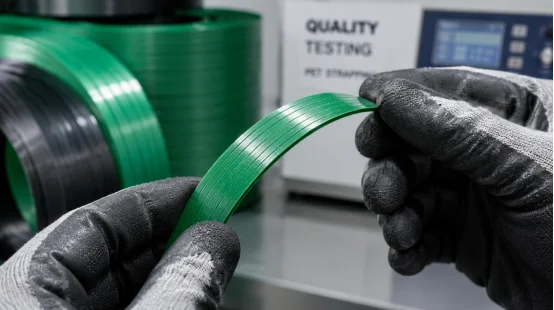
Brittle PET strapping is not always obvious at first glance. Smooth embossing and a clean surface do not prove enough toughness. A quick hands-on check often reveals more.
Common Signs of Brittleness
Cracking after one or two bends, heavy white stress marks, edge splitting, or sudden breakage under tension are warning signs. Good PET material should keep useful flexibility and rebound after bending. If the strap feels unusually stiff and snaps with little deformation, PET strapping brittleness may already affect performance.
That weakness may appear only after forklift movement, vibration, or pressure at a corner.
What Are the Main Causes of Brittle PET Strapping?
The main causes of brittle PET strapping are closely tied to heat, material condition, and process stability. PET strap is made by extrusion and stretching, so process changes can later show up as poor toughness or inconsistent breaking force.
Excessive Heat and PET Thermal Degradation
Too much heat for too long can lead to PET thermal degradation. The polymer loses part of its physical performance, making the finished strap less able to bend or absorb shock. Stable temperature matters more.
Improper PET Strapping Drying Conditions
PET strapping drying conditions need close control. Drying is necessary, but unnecessarily long heating adds thermal exposure. Production needs a controlled drying window, not a “longer is better” rule.
PET Strapping Extrusion Temperature and Frictional Heat
PET strapping extrusion temperature is only part of the heat load. Mechanical friction inside the extruder also creates heat. If heating, screw action, and residence time become excessive, PET molecular degradation may follow. The strap can still look normal while toughness drops.
Raw Material Quality
High-quality PET raw materials generally provide better texture and tensile performance than poor or inconsistent feedstock. For high quality PET strapping, raw material selection and stable processing need to work together.
How Does PET Strapping Brittleness Affect Packaging Performance?
A brittle strap is more than a cosmetic defect. It can affect packing speed, load security, and waste. The biggest concern is sudden failure under tension, especially with heavy loads or hard package edges.
Lower Flexibility and More Breaks
PET strapping needs controlled flexibility to handle movement during transport. When toughness drops, vibration, impact, and repeated bending become harder to tolerate. Electric, pneumatic, and manual tools also place concentrated force on the strap.
If PET strapping tensile strength is inconsistent, the strap may break before target tension is reached. Width and thickness should also match the strapping equipment in use.
A failed strap also means repacking, lost operator time, and more scrap.
How to Prevent PET Strapping from Becoming Brittle?
If you want to know how to prevent PET strapping from becoming brittle, start with process control. Once degraded material has become finished strap, inspection can find the problem but cannot reverse it.
Improve PET Strapping Temperature Control
PET strapping temperature control should cover heating time, melt condition, and process stability. Sudden changes deserve attention because they may show that the material is receiving too much thermal load.
Keep the PET Strapping Production Process Stable
A stable PET strapping production process needs consistent raw material preparation, extrusion, stretching, cooling, and winding. Width and thickness should stay uniform because dimensional changes can affect machine feeding and sealing.
Strengthen PET Strapping Quality Control
PET strapping quality control should combine real-time checks with regular sampling. Useful items include width, thickness, surface condition, edge quality, flexibility, tensile performance, and bonding or welding behavior. Catching a drifting process early also reduces wasted material.
How to Test PET Strapping Quality?
If you are receiving material, how to test PET strapping quality should not become a laboratory-only question. A few practical checks can flag trouble before a full production run.
Use a PET Strapping Bend Test
A PET strapping bend test is quick. Bend a sample repeatedly and watch the rebound. Good strap should stay flexible without cracking directly. Heavy whitening, splitting, or a brittle snap is a warning.
Check PET Strapping Breaking Strength
PET strapping breaking strength changes with width and thickness. Current specifications cover widths from 9 mm to 32 mm and listed breaking forces from 1,920 N to 15,360 N. Do not choose by width alone. Match the strap to load weight, edge condition, transport conditions, and machine requirements.
Inspect Dimensions, Surface, and Edges
Measure several points across the roll. Look for uneven thickness, rough edges, impurities, or irregular embossing. Dimensional problems can cause machine jams and unstable seals.
How to Choose High Quality PET Strapping?
A buyer should compare performance, consistency, and fit for the packing line. Price per roll matters, but it says little about how consistently that roll performs.
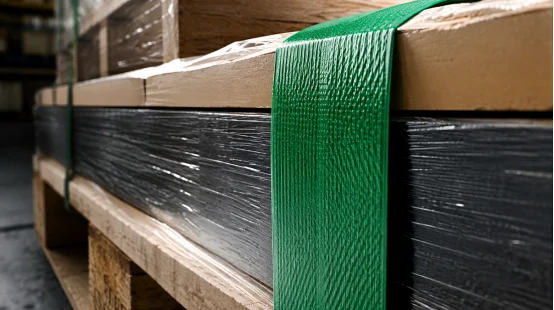
Check flexibility, PET strapping tensile strength, PET strapping breaking strength, width tolerance, edge finish, and welding behavior. For PET strapping for industrial packaging, also consider the load type. Timber, metal, building materials, and textile loads do not create the same stress. Sharp corners may still need edge protection.
A capable PET strapping manufacturer should discuss your machine, strap size, load weight, and required breaking force. A PET strapping supplier that asks these questions gives you more useful information than one that only quotes a roll price.
What Production Capability Helps Reduce Brittleness Risk?
Once the basic checks are clear, supplier capability matters because brittleness is closely linked with repeatable production and inspection. The useful question is whether material and process conditions can stay consistent from sample to bulk order.
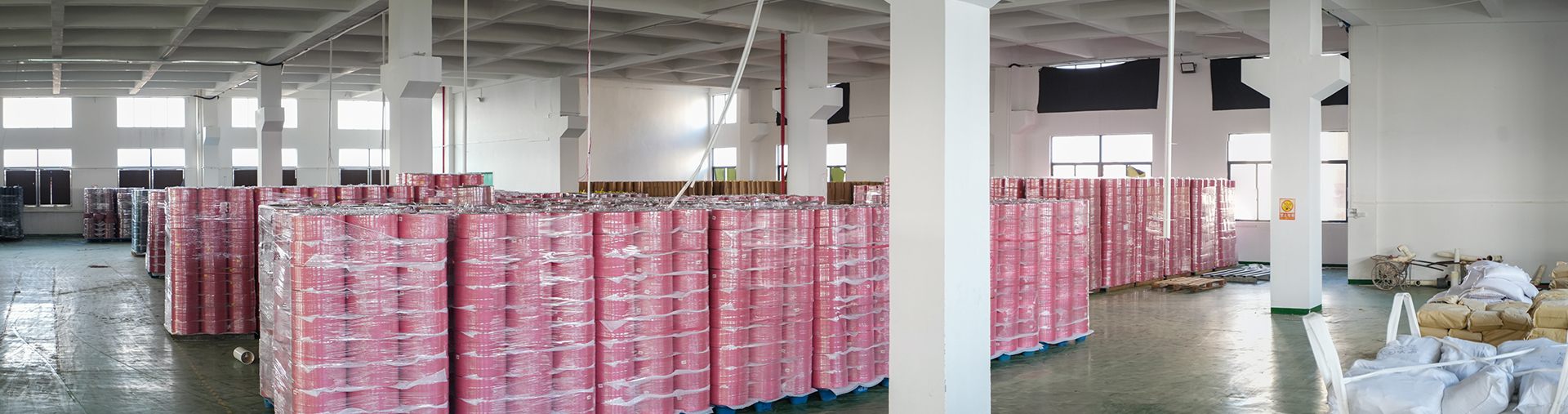
Weide Chuangyi Packaging produces PET and PP strapping within a broader packaging-material range and supports related strapping equipment and accessories. Its PET range lists multiple widths, thicknesses, and breaking-force levels, with customization available for selected specifications.
Product guidance also covers bend testing, edge condition, machine compatibility, and load-based strap selection. These capabilities matter when comparing samples, confirming machine-fit specifications, or reducing brittle material on the packing line.
FAQ
Q1: Why does PET strapping become brittle?
A: Excessive heating, improper drying conditions, frictional heat during extrusion, PET molecular degradation, and inconsistent raw material quality can contribute to brittleness.
Q2: Can PET strapping look normal but still be brittle?
A: Yes. Some problems appear only when the strap is bent, tensioned, welded, or exposed to handling stress. A bend test and tensile check are more useful than appearance alone.
Q3: How can PET strapping quality control reduce waste?
A: Real-time process checks and regular sampling can catch changes in temperature, dimensions, flexibility, or tensile performance before a large batch becomes scrap.
Q4: What should you check before buying PET strapping?
A: Check width, thickness, flexibility, PET strapping tensile strength, breaking force, edge quality, and compatibility with your strapping tool or machine.
Q5: Is a higher breaking force always better?
A: No. The correct value depends on load weight, package shape, edge condition, transport stress, and equipment. A stronger strap may add cost without solving the actual packaging problem.
