

How to Calculate the Required Strapping Break Strength for a Pallet Load
2026-07-31
The required strapping break strength cannot be calculated from pallet weight alone. Buyers must consider transport forces, effective straps, joint efficiency, applied tension, load settling, and a safety factor. A PET strap may suit a heavy or settling pallet, while a PP strap often works better for cartons and lighter bundles. Calculate the minimum nominal strength per strap after joint losses. Never turn pallet weight directly into a strap rating.
Important
Strap break strength is different from working tension and complete strapping-system strength. Validate the final packaging with a full pallet test under expected transport conditions.
Quick Answer: What Determines Required Strapping Strength?
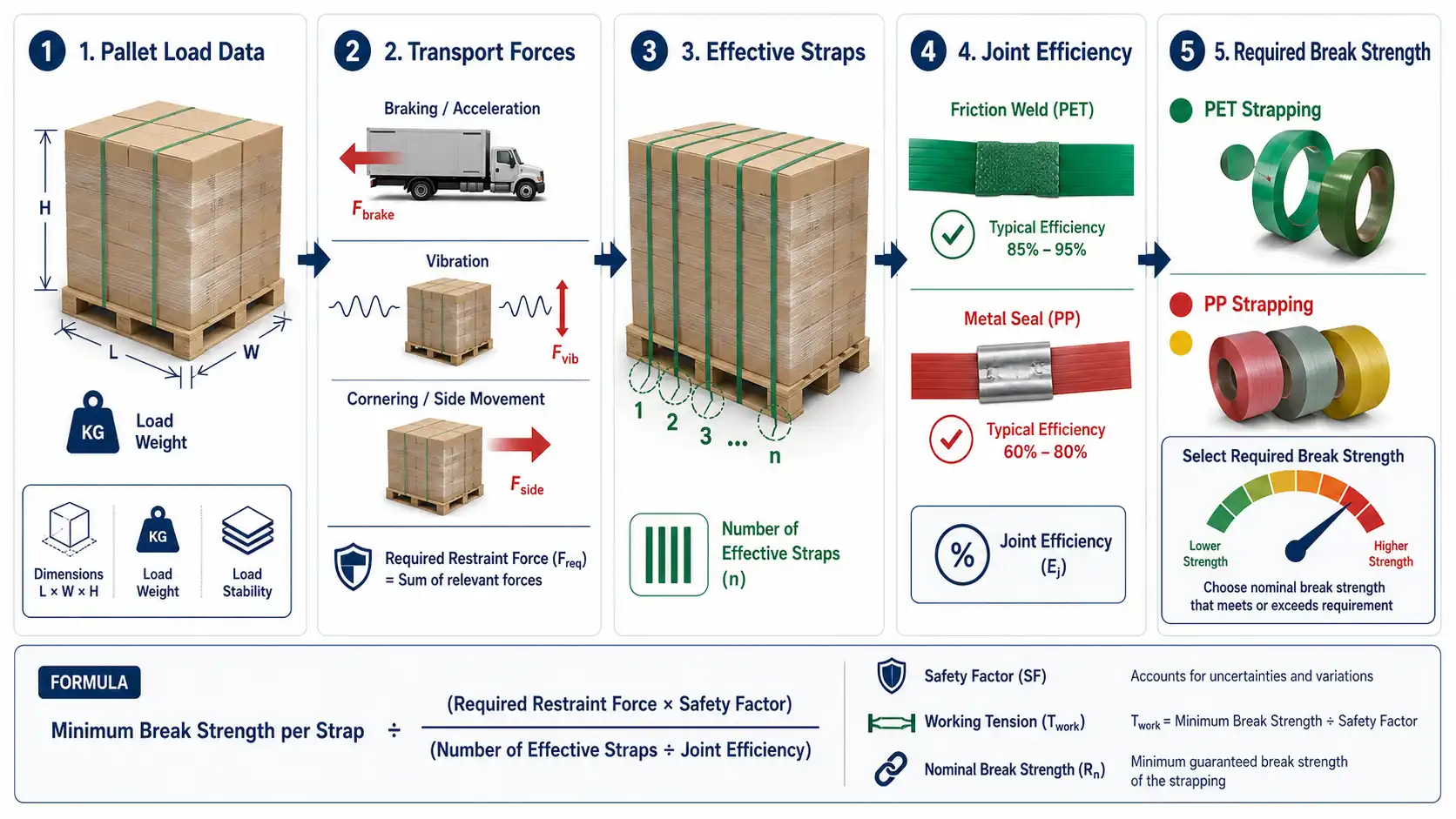
Six inputs drive the preliminary result: pallet and cargo weight, load stability, transport severity, number of effective straps, joint efficiency, and the safety margin. The calculation path is straightforward.
Load data → required restraint force → effective straps → joint efficiency → safety factor → minimum nominal break strength.
The difficult step is defining restraint force. It depends on acceleration, handling, route, packaging, and applicable transport requirements, not weight alone.
What Does Strapping Break Strength Mean?
Catalogue values can describe the unjoined strap or a complete system. Confirm which one. The finished pallet relies on the strap, joint, tool, package edges, and strap direction working together.
Nominal Break Strength
Nominal strapping break strength is the maximum force an unjoined strap withstands before failure. Suppliers may state it in newtons, decanewtons, kilogram-force, or pounds-force. It is not a tension setting. Weide Chuangyi Packaging lists PET strapping breaking force specifications from 1,920 N to 15,360 N by model.
System Strength and Joint Efficiency
System strength equals nominal strength multiplied by joint efficiency. A 5,000 N strap with an 80% tested joint provides 4,000 N. Heat seals, friction welds, metal seals, and wire buckles differ, so use data from the actual strap and tool.
Working Tension
Working tension is the force applied during packaging and should remain below break strength. Too little tension allows movement. Too much can crush cartons, damage corners, or weaken the joint. A polypropylene strapping tensioner or PET strapping tool needs a setting matched to the package surface and strap grade.
Why Pallet Weight Alone Is Not Enough
A rigid metal load and soft cartons can weigh the same yet need different restraint. Rigid loads may demand higher holding force and abrasion control. Compressible cartons need limited surface pressure. Timber or paper may settle, making recovery and tension retention important. Ceramics need edge protection; mixed cartons need careful placement. Pallet load stability depends on strap material, joint, cartons, corners, pallet condition, and transport direction.
The supplied knowledge base describes PP strapping band as a lightweight polypropylene product used mainly for cartons. PET strapping for pallets offers steel-like strength, impact extension, recovery, and safer edges than steel. Those properties explain why PET banding is often considered for wood, metal, building materials, ceramics, paper, and long-distance loads.
Inputs for a Pallet Strapping Strength Calculator
Record gross weight, pallet footprint, load height, centre of gravity, packaging form, compressibility, and settling risk. Add the transport route, handling frequency, vibration, loading operations, and any customer standard. Then enter vertical and horizontal straps, their directions, which straps resist the design movement, joining method, tested joint efficiency, safety factor, and required restraint force.
Do not assume every visible strap shares the same load. A band that keeps cartons aligned may contribute little to securing the load to the pallet.
Simplified Break-Strength Formula
For preliminary selection, use:
Minimum nominal break strength per strap = required total restraint force × safety factor ÷ effective straps ÷ joint efficiency
Required restraint force is an engineering input based on expected movement. Effective straps are the straps acting in the direction being checked. Joint efficiency must come from the real tool or seal test. The result narrows the specification range; a pallet test still decides whether the system works. The interaction among breaking force, elongation, and recovery rate also matters when a load settles.
Step-by-Step Calculation Process
Start with measured load data and make every assumption visible. An engineer can then review the restraint requirement, joint value, or strap count.
Record the Pallet and Cargo
Document gross weight, dimensions, centre of gravity, edges, packaging, and settling risk.
Set the Design Restraint Requirement
Use low, medium, or high transport severity for screening. Braking, turning, forklift impact, vibration, and repeated handling produce different forces. Confirm the requirement against the applicable standard and customer specification.
Count Effective Straps
Check each direction separately. Cross straps do not automatically provide longitudinal restraint, and four straps rarely share force perfectly.
Apply Joint Efficiency and Safety Factor
Reduce nominal strength by the tested joint percentage, then allow for uncertainty, material variation, temperature, settling, tool condition, and operator error. Avoid one safety factor for every industry.
Match the Result to PP or PET
Automatic-machine PP models span 12 to 15 mm, 0.5 to 1.0 mm, and at least 1,100 to 1,800 N. PET options span 9 to 32 mm and 1,920 to 15,360 N. Also check roll, core, and machine compatibility.
Worked Example: Light Carton Pallet with PP Strap
Assume a packaging engineer has already set a 2,400 N total restraint requirement for one direction. Four straps are effective, the tested joint efficiency is 75%, and the preliminary safety factor is 1.5. The minimum nominal strength is 2,400 × 1.5 ÷ 4 ÷ 0.75 = 1,200 N per strap.
A listed 12 mm × 0.60 mm PP strap has a minimum force of 1,200 N, leaving no room for changed assumptions. Compare the next grade, test seals, and check carton deformation. Higher tension cannot replace adequate strap strength. Edge protectors may be needed.
Worked Example: Heavy Rigid Pallet with PET Strap
Assume an approved design restraint of 12,000 N, four effective straps, 80% joint efficiency, and a 1.5 safety factor. The result is 12,000 × 1.5 ÷ 4 ÷ 0.80 = 5,625 N per strap. A listed 16 mm × 0.9 mm PET strap provides 5,760 N nominal breaking force, while a 19 mm × 0.8 mm option provides 6,080 N.
The closer option still needs validation for impact, edge wear, joint consistency, and retained tension. Settling timber or bundles may benefit from PET recovery.
PP vs. PET After the Calculation
Before raising the tool setting on either material, review how to prevent pallet damage from excessive strapping tension.
|
Factor |
PP Strap |
PET Strap |
|
Typical duty |
Light to medium |
Medium to heavy |
|
Tension retention |
Lower |
Better for settling loads |
|
Common uses |
Cartons, light bundles |
Timber, metal, building materials |
|
Selection concern |
Carton crushing, relaxation |
Edge wear, tool compatibility |
PP band costs less and suits controlled carton work. A PET strapping band usually provides a higher strength range and better recovery for long transport or settling cargo. Material choice follows the calculation and pallet test, not the material name alone.
Common Calculation Mistakes
Frequent errors include treating pallet weight as required strength, ignoring joint efficiency, dividing force equally among all straps, using break strength as the tension setting, missing load settlement, overlooking corners, adding straps without checking direction, relying on catalogue data without batch tests, mixing force units, and skipping pallet validation.
How to Validate the Specification
Inspect cartons and edges after tensioning, record initial tension, and recheck after the load rests. Simulate forklift handling and the expected vibration, tilt, or transport cycle. Examine joints, corner wear, strap movement, breakage, and tension loss. Record the strap batch, tool, settings, seal, and failure location so the next test changes one variable at a time.
Weide Chuangyi Packaging operates from a 10,000 m² facility in Foshan and traces its packaging-material business to 2004. Its range includes PP and PET strapping, automatic and semi-automatic machine strap, stretch film, packaging tools, and paper corner protectors. PET models cover 9 to 32 mm widths and published breaking forces from 1,920 to 15,360 N, while automatic PP models provide lower-strength options for lighter work. Custom width, thickness, color, roll weight, and printing are available subject to specification review. For a technical order, buyers should send the pallet profile, required force, joining method, machine information, and test expectations. That gives the supplier enough context to recommend samples rather than simply quoting the strongest roll.
Calculator Output and Purchasing Decision
A useful calculator should report total system strength, required strength per strap, minimum nominal strength, effective strap count, joint assumption, suggested PP or PET category, warning, and validation checklist. Label the result “Preliminary specification for sample testing.” Never promise that one strap is guaranteed safe. Buyers can also calculate strapping usage and cost per pallet after confirming strap length and the tested configuration.
FAQ
Q1: Is Strap Break Strength the Same as Tensile Strength?
A: Suppliers sometimes use the terms loosely. Confirm the test method, units, specimen, and whether the value describes unjoined material or joined-system strength.
Q2: How Much Break Strength Is Needed for a 1,000 kg Pallet?
A: Weight alone cannot answer it. Define restraint force from transport conditions, count effective straps, apply tested joint efficiency and a justified safety factor, then validate the complete pallet.
Q3: Does Using Four Straps Divide the Required Strength by Four?
A: Only when all four act in the checked direction and share force as assumed. Placement, geometry, tension variation, and corners can upset that simple division.
Q4: Should Working Tension Equal Strapping Break Strength?
A: No. Break strength is a failure limit; working tension is applied during packing. Excessive tension can crush cartons or damage joints. Set it through trials and recheck after resting and handling.
Q5: Is PET Strapping Stronger Than PP Strapping?
A: PET grades generally cover higher forces and retain tension better when loads settle. PP suits many cartons and lighter bundles. Select from the calculated requirement, joint, package sensitivity, equipment, and transport test.
