

PP Strap vs PET Strap: A Comparison in Packaging and Transportation
2026-07-23
Why Strap Selection Matters for Bulk Packaging Buyers
PP Strap vs PET Strap – the choice of packing strap for use in factories, warehouses, by wholesalers and by export packers. A simple item used in large quantities and under considerable stress as the goods are packed onto a pallet and then left for long periods until they are collected by the shipping line and then transported to the destination. If the wrong strap is chosen for the job then it is not long before boxes start to move, corners of the pallets break and items are unpacked and then re-packed – all a avoidable cost.
In packaging and in transport the best choice for the job depends very much on the actual load. A box of clothing will behave quite differently from a stack of paper cartons, from a pallet of tiles to a bundle of metal parts. When purchasing plastic strapping in large quantities, the buyer should first of all consider the actual load weight, the height of the pallets, the length of the transport route, the place where the goods will be stored, the available packing equipment and the required breaking force.
What Is PP Strap?
PP Strap for Light to Medium-Duty Packaging
PP strap or polypropylene strap is a light weight cost effective packaging strap, ideal for light to medium duty packaging, including carton tying, warehouse packaging, paper goods, clothing, boxed up items such as plates and much more. PP strap is easy to feed, easy to cut and convenient for your staff to use.
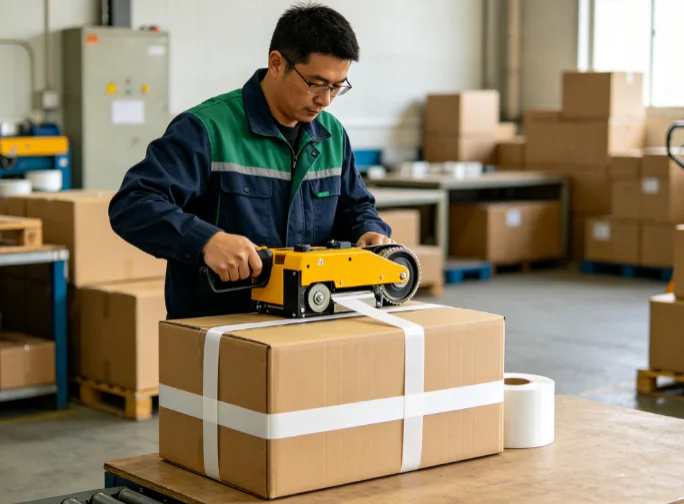
An example of packing where using PP strap would keep cost under control is a packing room sealing hundreds of cartons per day. A 12 mm or 15 mm PP strap would be sufficient to hold the cartons if they are of regular shape, not too heavy and stacked in a dry storage area before collection. Also PP strap can be used with manual, semi-automatic or automatic strapping tools.
When PP Strap Is the Better Choice
PP strap is generally the most suitable form of packaging when items are of a light to medium weight, are to be sent on a short delivery and buyer is looking for cost effective packaging. For retail products, warehouse sorting, carton closing and lightweight pallet wrapping PP strap is one of the more practical packaging solutions.
There are limitations to the use of PP strap. Heavy goods, sharp edged items, outside storage and long haulage are examples of where the strap could work loose too quickly. In these cases, PET strap may be more suitable.
What Is PET Strap?
PET Strap for Heavy-Duty Packaging
Our Polyethylene Terephthalate or PET strap is a much stronger plastic strapping for heavy duty packaging. It is used for pallet packaging, timber, building materials, cotton, fruit boxes, metal products, export packaging and much more. In comparison to our PP strap the PET strap has a higher tensile strength and better tension retention.
Here is a simple scenario to describe the use of PET strap in securing loads during their long distance transportation in order to prevent their uncontrolled movements during transit. A pallet of tiles is collected from a factory and then delivered to a port where it is loaded onto a sea going vessel. After the vessel arrives at the destination port the pallet of tiles is collected from the vessel and delivered to a customer by road using a truck. During transit the pallet may move due to the pallet being shaken, the items on the pallet settling or becoming unbundled due to the pressure of other items that are stacked on top of them. The use of PET strap allows the strap to hold the load firmly in place to prevent it from becoming unsecured during the long distance transportation.
Why PET Strap Supports Transportation Safety
The PET strap is also suitable for goods that are stored outside, exposed to temperature changes or frequently handled with a forklift. The strap is strong, but does not have any sharp steel-like edges. This means that your staff is protected and the packed goods are also protected from scratches.
As for many bulk buyers, the main reason to select PET strap over other types of straps, is not its strength, but rather its ability to improve load stability and improve transportation safety when shipment risk is higher.
Key Differences Between PP Strap and PET Strap
Strength and Tension Retention
The main differences between PP strap and PET strap are primarily around performance. PP strap is lighter, softer and more cost effective for many carton-based applications, whereas PET strap is stronger and enables better tension to be held over time.
When comparing the strength of PP straps versus PET straps for the heavy pallets, export goods and industrial products, we would generally recommend using the PET strap for heavy cartons that are likely to be subject to some degree of compression, or are left on the pallet for days before collection for shipping. In these cases, the better tension retention of PET will ensure the load stays tight.
Cost and Application Judgment
Comparing the cost of PP strap to PET strap should not just be a simple roll price comparison. For lighter packaging applications, and high volume carton packing applications where weight and efficiency are paramount then PP strap can save money. However, PET strap may cost more in terms of roll price than some other types of packaging strap, however it can save money in terms of reduced loose pallets, reduced product movement, reduced damage claims, and reduced time spent repacking damaged shipments.
Before purchasing a binding strap, purchasing teams should compare several criteria of different strap types for pallet packaging: strap width, strap thickness, breaking force, roll length, sealing method, tool type and the actual load condition. The best strap for a specific application is the one that is suitable for the job and not just the cheapest roll.
Brief Introduction to Weide Chuangyi Packaging
Weide Chuangyi Packaging is a supplier of packaging materials. It is a combination of R&D, production and sales. With years of experience in the industry since 2004, the company is located in a production base of approximately 10,000 square meters. Our products are PP strap, PET strap, fully automatic PP strap, semi-automatic PP strap, stretch film, paper corner protectors, etc, and relevant packaging tools.
The widths and thicknesses for PP strap are usually: 12 mm to 16 mm and 0.5 mm to 0.8 mm respectively. In this way, the packing can be done by hand or by machine. For PET strap, there are various widths from 9 mm up to and including 32 mm, in thickness from 0.6 mm up to and including 1.2 mm, and also various breaking forces. So also for carton packing, in warehouses, on pallets, for packaging for heavy transport, wholesale customers have plenty of choices.
Conclusion
PP strap and PET strap are both used for packaging and transport. In terms of their applications, PP strap is suitable for light to medium-duty packaging while PET strap is ideal for heavy-duty packaging. Besides, PET strap is suitable for very large loads which are to be packed on pallets, for export packaging and for long transport routes. For tensile strength, tension retention, weather resistance, load stability and safe transport, PET strap is usually the better choice.
FAQ
Q1:How do I know whether PP strap is strong enough for my cartons?
A:PP strap is usually sufficient for light to medium weight cartons stored indoors and traveling short, steady routes. Before placing a large order for bulk packaging supplies, verify the weight of the packaged goods, the stacked height, the strap width and thickness, and the packaging supply’s rated breaking force.
Q2:When should PET strap be used instead of PP strap?
A:PET strap is recommended for heavy goods, goods on a pallet, which are kept outdoors or transported over long distances. For stronger tension holding power and higher load stability, we recommend the use of PET strap.
Q3:What causes strapping to loosen during transportation?
A:Strapping can come loose when cartons collapse, pallets drop, there is too much vibration, wrong material used for strapping. Seals not closed properly, strapping not tight enough, wrong tools used for strapping.
Q4:What is the best strap for pallet packaging?
A:When it comes to pallet packaging, a number of factors need to be taken into account when deciding on the best strap for the job. Packaged items and the shipping route are two of the most important factors to consider. PP strap is perfectly adequate for lighter pallets, however for heavier pallets PET strap is generally more suitable for heavy-duty packaging, export packaging and long distance transportation.
Q5:Is PET strap better than PP strap for all packaging jobs?
A:PET strap is not always better than PET strap, although it is stronger. For light packaging, carton bundling and general warehouse packaging, PP strap is often the more cost-effective option. This depends on the type of goods, the machine, the route to market and your budget.

